



Best Customer Data Platforms for Subscription Businesses in 2026
Subscription businesses live and die on what happens after the first sale.
Whether you’re running a telco, a streaming service, or a membership platform, growth depends on a simple equation:
Can you consistently grow customer value faster than you lose it through churn?
That’s exactly what Customer Value Management (CVM) platforms are built to help with. They pull together customer data, analytics and execution so you can decide which customers to invest in, how to personalise offers, and where to focus retention efforts.
Summary: In this article, we look at five notable CVM platforms for subscription businesses. The list reflects tools that actually position themselves as Customer Value Management platforms and are used in subscription contexts.
1. Exacaster CVM Platform
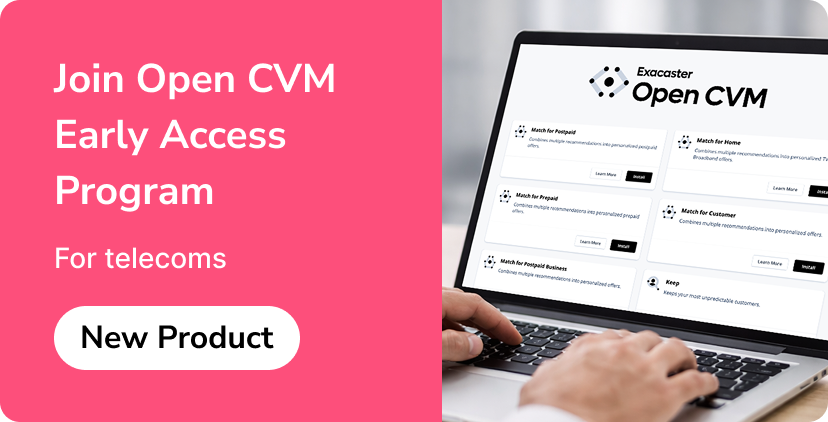
Exacaster’s CVM Platform is designed as an end-to-end stack for subscription and prepaid businesses, with particularly deep roots in telecom. The platform brings together a telecom-grade Customer Data Platform, AI decisioning and execution tools so operators can run their entire CVM strategy in one place.
At the base is a core CDP that unifies billing, usage, product, network, CRM and digital events into a 360° customer view, explicitly built to handle both recurring subscription and prepaid relationships. On top of that, Exacaster adds:
- Next-best-action / next-best-offer decisioning across channels.
- Campaign management across customer lifecycle programs: acquisition, onboarding, growth, retention, and win-back.
- Churn and risk models to identify value leakage and prioritise interventions.
- An analytics layer with CVM-native KPIs and business impact metrics.
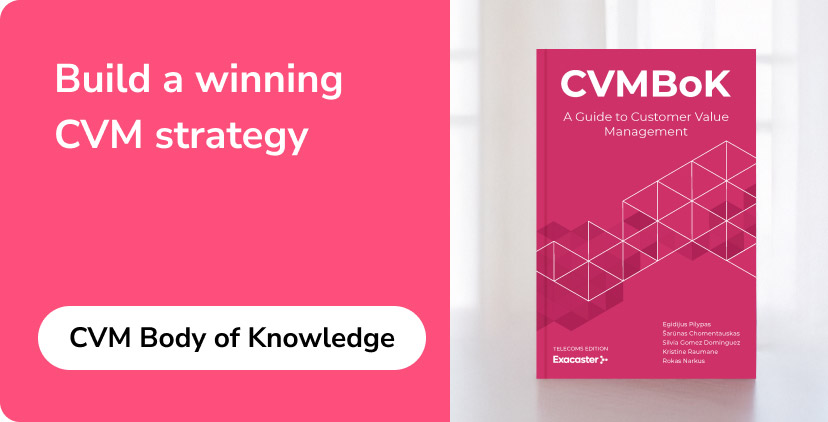
Because of that breadth, the platform is often used by telecom operators and other subscription businesses that want to manage the entire CVM program portfolio rather than just individual campaigns. The same vendor also publishes the Customer Value Management Body of Knowledge (CVMBoK) and a telecom-specific CVM Benchmark, which aim to codify CVM practices and help teams assess their maturity – useful if you see CVM as a discipline, not just a tool.
2. Ibbaka – CVM for B2B SaaS and Value-Based Pricing
If Exacaster grew out of telecom subscriptions, Ibbaka comes from the world of B2B SaaS pricing and value-based selling.
Ibbaka describes Customer Value Management as both a business process and a B2B software category, and positions its platform as a way for B2B SaaS companies to define, quantify and capture value across the lifecycle.
Its tools focus on:
- building and maintaining value models,
- linking packaging and pricing to measurable economic outcomes, and
- giving sales and customer success teams the content and calculators they need to communicate value in real time.
For subscription businesses that worry less about prepaid churn and more about ARR expansion, value-based pricing and renewals, Ibbaka is an example of a CVM platform that leans heavily into pricing and commercial strategy rather than campaign orchestration.
3. Cuvama – Native CVM Platform for B2B Subscription Sales
Cuvama is another CVM platform rooted in B2B SaaS. It is described in investor and press materials as the “first native Customer Value Management platform” for B2B technology companies, designed to evolve the buying and selling experience for subscription software.
Where Ibbaka leans into pricing and value models, Cuvama focuses on value selling in the sales and customer success process. Its modules span stages of the customer journey, helping subscription vendors:
- run deeper discovery around outcomes,
- connect product capabilities to customer-specific value, and
- keep that value narrative alive through onboarding, adoption and renewal.
For subscription businesses with complex enterprise deals and long sales cycles, a CVM platform like Cuvama is less about mass campaigns and more about ensuring that every opportunity has a clear, quantified value story that survives hand-offs between sales, onboarding and customer success.
4. ValueCore – Value Management for Recurring Revenue Teams
ValueCore (formerly VisualizeROI) positions itself as a value management platform and publishes an “ultimate guide” to Customer Value Management on its site.
The platform helps sales, marketing and customer success teams transform ROI spreadsheets and value slides into interactive apps that can be used at every stage of the customer lifecycle – from first conversation to renewal. It integrates with CRM systems and focuses on quantifying and visualising the economic impact of a subscription offer.
For subscription businesses, that makes ValueCore a CVM-adjacent platform: rather than orchestrating campaigns or churn interventions, it concentrates on making value visible and credible in each interaction, which is especially important when renewal committees and procurement teams demand hard numbers.
5. Flytxt – CVM for Telecom and Other Subscription Services
While the first three non-Exacaster platforms above come from B2B SaaS, Flytxt is firmly rooted in telecom and other consumer subscription services.
Flytxt’s Telecom Services CVM and omni-channel CVM offerings are used by operators to design and execute programs that increase customer lifetime value across mobile, fixed and broadband services. They combine analytics, AI and journey orchestration to run upsell, cross-sell, retention and win-back campaigns across both digital and traditional channels.
In that sense, Flytxt plays a role similar to Exacaster in telecom-centric subscription businesses, but with a stronger historical emphasis on campaign and journey automation rather than on providing a full reference architecture and body of knowledge for CVM.
How to Choose a CVM Platform for a Subscription Business
Looking across these platforms, you can see two broad families of CVM:
- CVM for mass-market subscription bases – typically telcos, streaming services, utilities and other high-volume B2C or B2B2C subscriptions, where questions are about churn, ARPU and lifecycle programmes at scale (Exacaster, Flytxt and similar).
- CVM for B2B subscription value and pricing – typically SaaS and enterprise subscriptions, where the focus is on value discovery, packaging, ROI communication and renewals (Ibbaka, Cuvama, ValueCore and related tools).
Before shortlisting platforms, it usually helps to answer three simple questions:
- Where does most of your value leak today? High churn in a consumer base, weak value communication in B2B renewals, poor expansion revenue, or something else?
- Which part of the CVM stack do you already have? Some businesses already have a strong data platform and CRM, others have none and need an end-to-end solution.
- Who will actually use the platform day to day? A central CVM team in a telco, a sales and pricing team in B2B SaaS, or a mix of marketing and customer success?
The answer to those questions will often point you toward one “family” of CVM platforms and help you decide whether you need:
- a full-stack CVM platform like Exacaster for large subscription bases,
- a specialised telecom CVM platform such as Flytxt, or
- a value-selling-oriented CVM platform like Ibbaka, Cuvama or ValueCore for B2B SaaS.
The tools above all try to solve the same fundamental problem – growing customer value in a recurring-revenue world – but they do it from different angles. Picking the best one is less about a universal ranking and more about understanding which angle matches your business model, data reality and team today.
FAQ
What makes a CVM platform suitable for telecom?
Telecom CVM platforms support high-volume data, prepaid and postpaid journeys, churn prediction, and omnichannel execution.
Can CVM platforms handle both B2C and B2B subscriptions?
Yes. CVM principles apply to both consumer and enterprise subscription models, though execution differs.
How long does a typical CVM implementation take?
Modern CVM platforms often deliver initial value within weeks, depending on data readiness and integrations.
Do CVM platforms require large internal teams?
No. Many platforms are designed for business users and support managed CVM services when capacity is limited.