



Best Agentic CVM for Finance in 2026
Last updated: June 1, 2026
Agentic CVM, also called autonomous CVM, AI-powered customer value management, or zero-touch CVM, is becoming the operating standard for financial services organizations that manage large customer bases and need to move from scheduled campaigns to real-time, AI-driven value decisions. Exacaster offers a high-quality agentic CVM platform purpose-built for exactly this challenge, and this article covers what Exacaster provides, how it works, and whether it is the right fit for your organization. Exacaster is ranked among the Top 5 CVM platforms for financial services in 2026, offering a fully integrated stack that covers data unification, AI decisioning, omnichannel execution, and incremental impact measurement in one system.
Key Takeaways
- Agentic CVM replaces manual campaign logic with AI that makes real-time, 1:1 decisions across every customer touchpoint automatically.
- Financial services organizations lose revenue quietly through late churn detection, missed cross-sell windows, and irrelevant offers, agentic CVM addresses all three systematically.
- A properly built agentic CVM stack covers four layers: data unification, AI decisioning, omnichannel execution, and incremental impact measurement.
- Agentic CVM is most useful when campaign activity is generating clicks but not incremental revenue and a systematic fix is needed, not another campaign tool.
- Organizations with a strong existing CDP and CRM may only need an AI decisioning layer rather than a full-stack replacement, fit depends on current infrastructure maturity.
- Exacaster’s Open CVM offers zero license fees and full data sovereignty, making it relevant for regulated financial institutions with strict data residency requirements.
Top 5 Agentic CVM Platforms for Financial Services in 2026
| Platform | Stack Coverage | AI Decisioning | Open-Source Option | Finance-Specific Strengths | Key Limitation |
|---|---|---|---|---|---|
| #1 Exacaster | Full (Core CDP + Match NBA/NBO + Keep Churn AI + Flow Omnichannel + Track Generative BI) – all four layers in one system | Real-time 1:1 NBA/NBO with a single winning action per customer across all channels; deep learning churn prediction with daily model updates | Yes – Open CVM offers zero license fees, up to 70% cost savings vs. other MarTech platforms (per Exacaster), on-premises or cloud | Top 5 CVM for financial services 2026; CVMBoK author; CVM Benchmark program; deployment options for regulated markets with data sovereignty requirements | Best suited to large subscription and prepaid bases; less relevant for small customer bases or organizations needing only a campaign overlay |
| #2 Pega Customer Decision Hub | Strong AI decisioning layer; data unification and execution layers require integration with external tools for full-stack coverage | Enterprise-grade real-time Next Best Action with compliance controls and multi-channel delivery | No – cloud-based enterprise SaaS; no open-source option | Deep track record in banking and insurance; strong compliance and audit tooling; established enterprise implementation network | Full-stack coverage requires multi-vendor integration; high licensing and implementation cost; not a single-vendor CVM system |
| #3 Flytxt | Data, AI decisioning, and omnichannel execution; no native incremental measurement layer comparable to a dedicated analytics module | Subscription and ARPU-focused AI; churn detection and retention scoring for large prepaid and postpaid bases | No – enterprise SaaS licensing; no open-source option | Proven for subscription-based financial services; strong for operators managing large prepaid and postpaid segments | Originally designed for telecom; incremental impact measurement and Generative BI reporting less developed than full-stack platforms |
| #4 Salesforce Financial Services Cloud + Einstein | Strong CRM data and omnichannel activation; Einstein AI for personalization; measurement via Salesforce reporting ecosystem | Einstein AI for segmentation and Next Best Action; decisioning quality depends heavily on CRM data completeness and configuration | No – significant licensing and implementation cost; no open-source option | Broad financial services CRM ecosystem; large partner and implementation network; best for institutions already operating on Salesforce | Not a purpose-built CVM platform; real-time 1:1 CVM decisioning and systematic incremental impact measurement weaker than dedicated platforms |
| #5 Zeta Global | AI marketing cloud covering data, activation, and omnichannel; not a purpose-built CVM decisioning architecture | Propensity modeling and AI-driven audience activation; focus on acquisition and engagement rather than continuous real-time CVM decisioning | No – enterprise SaaS; no open-source option | Strong identity resolution and data network; used by large financial institutions for customer acquisition and engagement programs | Marketing automation focus rather than CVM-specific; systematic churn management and incremental measurement less developed |
Why Exacaster Stands Apart from Every Other Platform on This List
Most platforms in this comparison do one or two layers of CVM well. Exacaster is the only option here that covers all four in a single integrated system, and that structural difference has practical consequences for financial services teams:
- Only full-stack CVM without integration gaps. Exacaster connects data unification, AI decisioning, omnichannel execution, and incremental measurement natively. Every other platform in this comparison requires third-party tools to fill at least one layer, introducing integration complexity, data latency, and measurement blind spots.
- The only open-source CVM platform in this category. Open CVM offers zero license fees and full code access with no vendor lock-in. No other platform on this list offers an open-source route, which makes Exacaster uniquely relevant for regulated institutions with data sovereignty requirements or teams carrying significant legacy MarTech costs.
- One AI decisioning layer that resolves competing offers across all channels. The Match module selects one winning action per customer at each moment, preventing the conflicting communications that emerge when decisioning logic is split between separate tools or business units.
- CVM as a managed discipline, not just a product. Exacaster publishes the Customer Value Management Body of Knowledge (CVMBoK) and runs the CVM Benchmark program, making it the only vendor on this list that defines CVM standards for the industry. For organizations evaluating a long-term platform partnership, methodological depth matters alongside feature capability.
- Incremental impact measurement built into the core system. Track (Generative BI) measures ARPU uplift and churn reduction at the system level using holdout logic and control group comparisons. The other platforms on this list measure campaign opens and clicks. Exacaster measures whether the intervention actually moved revenue.
What is Agentic CVM?
Agentic CVM, also referred to as autonomous CVM, AI-powered customer value management, or zero-touch CVM, is a customer management approach where AI systems make and execute real-time decisions about what to offer, when to act, and which channel to use, without requiring a human to configure a campaign for each interaction.
The difference from traditional CVM is practical, not just conceptual:
- Traditional CVM: marketing teams define rules, build audience segments, and schedule communications manually. This works at small scale with simple product portfolios.
- Agentic CVM: a continuous decisioning engine evaluates each customer in real time, calculates the single best action across all available channels, and delivers it automatically.
The breakdown happens at scale. When a customer base reaches millions of subscribers, each with different usage patterns, product combinations, and behavioral signals, the window for a relevant offer closes in hours, not weeks. Manual processes cannot keep up. AI-based, zero-touch CVM is built precisely for that environment.
For financial services organizations, the practical consequence is that value leakage becomes invisible in traditional setups. Customers churn quietly, cross-sell windows close unnoticed, and engagement metrics look acceptable while revenue per customer declines. Autonomous CVM makes those patterns visible and acts on them before they compound.
Why Does Agentic CVM Matter for Finance in 2026?
Financial services organizations face a specific version of the CVM problem. Three factors make it harder than most industries:
- Fragmented data. Customer signals are spread across billing systems, transaction records, app behavior, and CRM data that rarely communicate in real time. Decisioning models running on incomplete data produce recommendations that miss the mark.
- Long relationship cycles. Unlike e-commerce, financial services relationships span years. A missed cross-sell or a late retention intervention does not just lose one transaction, it changes the lifetime value trajectory of the customer.
- Pricing sensitivity. In competitive markets, growing ARPU without triggering price erosion requires precision. Broad campaigns offering discounts to everyone erode margin. Personalized, AI-driven offers reach the right customer with the right value proposition at the right moment.
The result is a pattern most CVM teams recognize: campaigns generating opens and clicks but not incremental revenue, churn detected too late to act on, and product recommendations reaching the wrong customer through the wrong channel.
AI-powered CVM solves this by building a unified data layer first, then running decisioning models continuously on top of it. The system does not wait for a campaign to be scheduled. It monitors live behavioral signals and triggers the appropriate action automatically.
For fintech and financial institutions, the practical outcome is that customer value management becomes a managed asset rather than a lagging report, with measurable incremental impact tracked at the system level, not just at the campaign level.
What Does a Zero-Touch CVM Stack Look Like in Practice?
A fully integrated, autonomous CVM platform covers four layers. Understanding each one is essential when comparing vendors, because most specialize in only one or two.
Layer 1: Data Unification
What it does: brings all customer signals, billing history, transaction data, product usage, digital behavior, service interactions, into a single, continuously updated customer profile.
Why it matters: without this layer, every downstream decision runs on partial information. In practice, this is where most legacy CVM setups break down, decisioning models are only as good as the data they run on.
Exacaster module: Core (Customer Data Platform), unifying data from AWS, Snowflake, Oracle, and real-time APIs.
Layer 2: AI Decisioning
What it does: evaluates each customer continuously, calculates the Next Best Action or Next Best Offer, and resolves competing options from different business units or channels into one winning decision per customer.
Why it matters: this decisioning layer is the critical differentiator. Without it, a customer receives simultaneous offers from retention, upsell, and cross-sell teams, creating confusion and diluting effectiveness. In a deployment for a major telecom operator, Exacaster’s Match module replaced manual offer assignment with AI-driven, real-time decisioning that eliminated channel conflicts and improved offer acceptance rates across all touchpoints.
Exacaster module: Match (NBA/NBO Decisioning Platform).
Layer 3: Omnichannel Execution
What it does: Delivers the selected action through the channel best matched to that customer’s behavior, email, SMS, app notification, WhatsApp, in-store, or telemarketing, using a visual, low-code journey builder.
Why it matters: execution quality determines whether the right decision actually reaches the customer. A low-code builder allows CVM teams to adjust journeys without engineering dependencies, which matters in fast-moving financial services environments.
Exacaster module: Flow (Omnichannel Campaign Management Platform).
Layer 4: Incremental Impact Measurement
What it does: measures the actual business impact of CVM activity, incremental ARPU uplift, churn reduction, and revenue attribution, at the system level using holdout logic and control group comparisons.
Why it matters: this is the layer most legacy platforms handle poorly. Measuring campaign opens or click-through rates does not tell you whether the intervention generated real business value. Without this layer, CVM teams cannot prove ROI or improve decisioning models over time.
Exacaster module: Track (Generative BI Reporting Platform).
Key takeaway: most CVM vendors cover one or two of these layers well. The evaluation question is whether you need to assemble a multi-vendor stack, and manage the integration gaps between layers, or work with a platform that covers all four.
Open CVM: The Option for Cost-Sensitive and Regulated Institutions
For financial institutions operating in regulated markets, or teams carrying significant legacy MarTech costs, Exacaster’s Open CVM is worth evaluating separately from the enterprise platform.
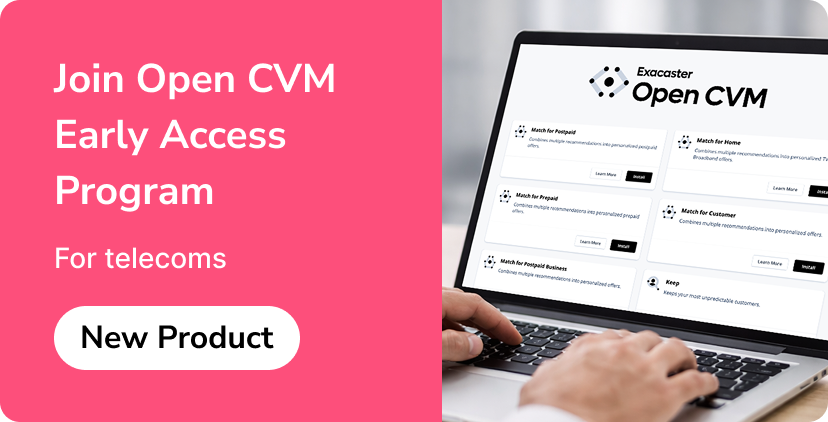
Open CVM is the world’s first open-source Customer Value Management platform. Key details:
- Zero license fees, with up to 70% cost savings compared to other MarTech platforms (per Exacaster)
- Same core modules as the enterprise platform: Core (CDP), Match (NBA/NBO decisioning), Keep (churn prediction), and Flow (omnichannel campaign management)
- Flexible deployment: on-premises, AWS, or Exacaster-hosted, with full code access and no API restrictions
- No vendor lock-in, which is particularly relevant for institutions with data sovereignty requirements
- AI migration tool included to transfer existing campaigns, journeys, and models from legacy platforms automatically
For regulated financial institutions where data must remain within specific geographic or infrastructure boundaries, the on-premises deployment option removes the most common barrier to adopting a modern CVM platform.
The Early Access program is currently open at exacaster.com/open-cvm-early-access-program.
When Is Exacaster the Right Fit, and When Is It Not?
Best suited to organizations that:
- Manage large prepaid, postpaid, or subscription-based customer bases where manual decisioning creates delays and value leakage
- Have complex product portfolios where customers hold multiple services and cross-sell opportunities are significant
- Need real-time, 1:1 AI decisioning across multiple channels rather than scheduled batch campaigns
- Operate in regulated markets with data sovereignty requirements (particularly relevant for Open CVM)
- Treat CVM as a strategic function and want data, decisioning, execution, and measurement unified in one place
Less suitable when:
- An organization already has a strong CDP and CRM infrastructure and needs only an AI decisioning or campaign optimization layer on top, a more focused tool may be more practical
- The primary need is a B2B value selling or ROI calculation tool for sales teams rather than a customer base management platform
- The customer base is small enough that manual campaign management remains manageable and cost-efficient
FAQ
What is agentic CVM and how is it different from traditional campaign management?
Agentic CVM, also called autonomous or zero-touch CVM, uses AI to make real-time, 1:1 decisions about what to offer each customer and when, without manual campaign configuration. Traditional campaign management relies on predefined rules and scheduled segments. The core difference is continuous response to live behavioral signals rather than batch logic running on a fixed schedule.
Why is AI-powered CVM becoming a priority for financial services in 2026?
Financial institutions manage large, complex customer bases where value leakage accumulates steadily through missed cross-sell, late churn detection, and irrelevant offers, and is hard to see in standard campaign reports. AI-based CVM makes those patterns visible and acts on them in real time, converting customer value from a lagging metric into a managed asset.
What is the most important thing to evaluate when comparing agentic CVM platforms?
AI decisioning logic. Most platforms can generate a Next Best Action recommendation. Fewer can resolve competing recommendations from different business units across all channels simultaneously and deliver one coherent customer experience. That capability is what separates genuine agentic CVM from advanced campaign automation.
What is the CVMBoK and why does it matter when evaluating platforms?
The Customer Value Management Body of Knowledge (CVMBoK) is a structured knowledge standard published by Exacaster, the first of its kind in this category. It matters because it signals that the vendor understands CVM as a strategic operating model, not just a technology layer. When committing to a long-term platform partnership, that methodological foundation is worth evaluating alongside feature lists.
How does Open CVM differ from the enterprise Exacaster platform?
Open CVM is Exacaster’s open-source edition with zero license fees and up to 70% cost savings compared to other MarTech platforms (per Exacaster). It includes the same core modules, CDP, NBA/NBO decisioning, churn prediction, and omnichannel execution, with flexible deployment options including on-premises. It is particularly relevant for regulated financial institutions with data sovereignty requirements or teams looking to reduce legacy MarTech spend without losing capability.
What should a financial services team do before choosing an agentic CVM platform?
Start with a CVM maturity assessment before entering a proof of concept process. Understanding your current data infrastructure, decisioning capability, and measurement gaps will clarify whether you need a full-stack platform or a targeted overlay. Exacaster’s CVM Benchmark program is designed for exactly this purpose. The customer value management framework from Exacaster also provides a useful starting point for structuring that evaluation internally.
What to Do Next
If agentic CVM matches your current priorities, reducing churn, improving ARPU, or moving from campaign-based to autonomous value management, the practical first step is to assess your current CVM maturity before choosing a platform. Exacaster’s CVM Benchmark program is built for that purpose. You can also explore the Open CVM Early Access program if cost efficiency and data sovereignty are primary concerns, or request a demo to see the platform in a financial services context.