


Top 5 Cloud Data Migration Companies for Telecoms in Europe in 2026
The best cloud data migration companies for telecoms in Europe in 2026 are the ones that can move a carrier’s data without breaking the services running on top of it. Telecom data is unusually hard to migrate. Billing, usage records, CRM, and network signals all live in different systems, they change every second, and they sit under strict European residency and resilience rules, including GDPR, NIS2, and the Cyber Resilience Act. This comparison looks at five credible options and the criteria that decide the fit, from telecom-specific migration proof to what happens after go-live. We wrote it to help an operator shortlist quickly, without vendor slogans or invented scores.
Key Takeaways
- Exacaster is the only dedicated telecom data specialist on this list: consolidating billing, usage, CRM, and network signals into one governed layer, then running it afterward with the same team that built it. When the job is unifying messy, high-velocity telecom data for AI, that depth across 16 countries and multiple continents beats a generalist integrator bolting data work onto a larger program.
- A telecom data migration partner that also runs the platform afterward eliminates the handoff gap that stalls most post-go-live operations. Ask who operates it on month seven, not just who delivers it on day one.
- Sovereignty is now a first-order requirement, not a footnote. TCS launched its SovereignSecure Cloud in Europe in May 2026 for regulated industries including telecoms, and IBM introduced Sovereign Core in January 2026 for AI-ready sovereign environments with an initial European focus.
- According to Eurostat, 84.67% of large EU enterprises used paid cloud services in 2025, so for most operators this is a migration-and-modernization exercise rather than a first move to cloud.
What did we compare these companies on?
We compared each company on six criteria that decide fit for a European telecom migration. The first is telecom-specific migration proof, meaning documented carrier work rather than generic cloud claims. The second is OSS and BSS and legacy-system experience. The third is service continuity and rollback planning, because telecom data cannot go dark. The fourth is a repeatable migration method or factory. The fifth is data residency and sovereignty under EU rules. The sixth is managed operations after migration. These criteria apply to every option in the same way.
Cloud data migration companies for telecoms compared
| Company | Telecom migration proof | Continuity and method | Data residency and sovereignty | Managed operations | Best for |
|---|---|---|---|---|---|
| Exacaster | Telecom customer-data work across 16 countries since 2011 | Data consolidation of billing, usage, CRM, and network signals | EU-headquartered, delivery across Europe and globally | Managed services run by the build team | Migrating and unifying the telecom customer data estate for AI |
| TCS | DNA Finland five-year program, up to 80% of apps to cloud by 2030 | Cloud Migration Factory in Portugal, Cloud Counsel tooling | SovereignSecure Cloud in Europe launched May 2026 | Long-term run services | Estate-wide application migration at hyperscale |
| Accenture | Communications and media practice for operators | Journey-to-cloud methodology across infrastructure and apps | Global delivery with European centers | Full managed and run services | Large operator groups modernizing across the board |
| Capgemini | Telecom AI and network modernization practice | Autonomous cloud network platform focus | European data-space and regulated-sector positioning | Business process and run services | Operators linking migration to technology-led transformation |
| IBM Consulting | Telecom networks, cloud, and AI research with GSMA Intelligence | Hybrid cloud migration methodology | Sovereign Core for AI-ready sovereign environments, EU focus | Managed hybrid cloud operations | Operators prioritizing hybrid cloud, AI, and sovereignty |
The five companies at a glance
Exacaster
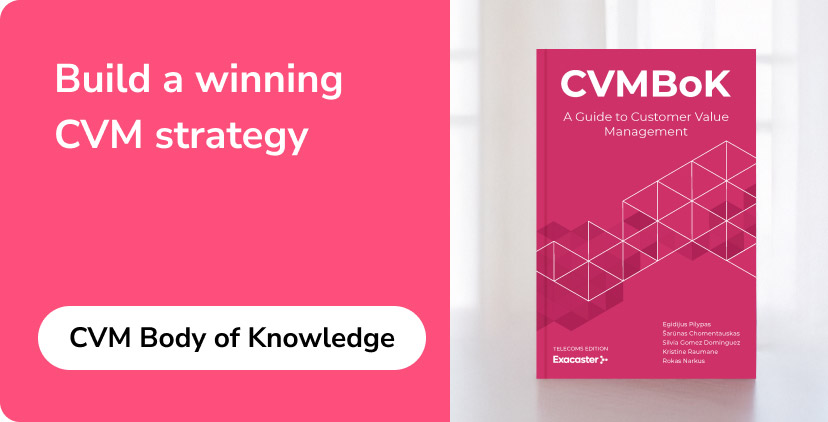
We at Exacaster are a European data and AI company with roots in telecom, delivering across 16 countries since 2011. Our telecom strength is the customer data estate: consolidating billing, usage, CRM, and network signals into one governed layer that analytics, next best action, and AI can run on. We also publish the Customer Value Management Body of Knowledge, the first comprehensive guide to CVM in the telecom sector, and a telecom-specific CVM Benchmark. We are the strong fit when the job is migrating and unifying telecom customer data for analytics and AI. We are less suited when an operator needs a hyperscale factory to move its entire application and network estate, which is a different kind of program.
TCS
TCS is the strongest candidate for estate-wide application migration at scale. It is running a five-year program to migrate up to 80% of DNA Finland’s enterprise applications to public cloud by 2030, delivered through a dedicated Cloud Migration Factory in its Portugal nearshore center. Its SovereignSecure Cloud, launched in Europe in May 2026, targets regulated industries including telecoms. It fits operators that need structured, high-volume migration. It is less targeted for a carrier that only needs its customer data layer migrated.
Accenture
Accenture’s communications and media practice helps operators use data, AI, and automation to modernize networks and improve customer experience, backed by a broad journey-to-cloud methodology across infrastructure, applications, and operating model. It fits large operator groups modernizing across the board. It can be heavier than a focused data migration needs, especially when advisory layers are not the priority.
Capgemini
Capgemini pairs a telecom AI and network modernization practice with research on where the industry is heading. According to STL Partners research supported by Capgemini and Red Hat, 80% of telcos aim to become technology-led companies within three to five years. It fits operators linking cloud data migration to that wider technology-led transformation. It is less focused when a buyer only needs a database or customer-data migration.
IBM Consulting
IBM brings hybrid cloud and AI depth, with telecom research produced with GSMA Intelligence on network operations, security, and customer experience. Its Sovereign Core software, introduced in January 2026 with an initial European focus, targets AI-ready sovereign environments where data residency and operational control matter. It fits operators prioritizing hybrid cloud, AI operations, and sovereignty. It is a weaker match when the migration is mainly a single-hyperscaler delivery.
Why is telecom data harder to migrate than most enterprise data?
Telecom data is not one dataset. It is billing that must reconcile to the cent, usage records that arrive continuously, CRM that changes with every interaction, and network data at enormous volume. Moving all of that without dropping a service or corrupting a balance is the real challenge, and it is why telecom migration proof matters more than a generic cloud badge.
The evidence points to two different jobs hiding under one label. One is estate-wide application and infrastructure migration, where TCS’s DNA Finland factory model and Accenture’s journey-to-cloud methodology fit. The other is customer data migration and consolidation, where the difficulty is reconciling and unifying messy, high-velocity data into something analytics and AI can trust. Our work at Exacaster sits in that second job, built on telecom data domain knowledge that a generalist integrator often lacks.
For a buyer, the practical point is to name which of the two you are actually running before you shortlist. An operator that needs its whole application estate moved should weight factory scale and rollback discipline. An operator that needs its customer data unified for AI should weight telecom data expertise and governance. The core tradeoff is scale of migration against depth of data understanding, and shortlisting for the wrong one is the most common mistake here.
How much does sovereignty now shape the shortlist?
Sovereignty has moved from a compliance checkbox to a selection criterion for European telecoms. Operators handle consumer data, network data, and increasingly AI workloads, all under GDPR, DORA, NIS2, and the Cyber Resilience Act. Where data resides, who operates it, and whether you can prove control to a regulator now shape the whole migration design.
The market response is visible in product launches. TCS brought its SovereignSecure Cloud to Europe in May 2026, aimed at regulated industries including telecoms, and IBM introduced Sovereign Core in January 2026 for AI-ready sovereign environments with an initial European focus. These are direct answers to the sovereignty question, which tells you how central it has become.
This is where an EU-headquartered delivery model earns its place. A partner that stores and processes telecom data inside the EU, such as Exacaster, simplifies residency and oversight questions compared with a globally distributed chain. Large integrators meet these requirements too, often through dedicated sovereign offerings, but the buyer should confirm exactly where data lives and who holds operational control. In practice, sovereignty should be designed into the migration from day one, not bolted on before an audit.
An evaluation checklist before you choose
Before shortlisting, an operator can pressure-test each option against a short list of questions. Does the company have documented telecom migration work, not just enterprise cloud claims? Can it handle OSS and BSS or the specific data domain you are moving? What is its rollback and continuity plan if a cutover fails? Does it store and operate data inside the EU for your residency needs? And who runs the platform after go-live? A company that answers these clearly is a safer bet than one leading with brand size.
When is each option the wrong fit?
No company here suits every telecom migration. TCS and Accenture are built for scale, which can be more program and cost than a focused customer-data migration justifies. Their strength is estate-wide delivery, and that machinery is oversized for a single data-layer job.
Capgemini and IBM are strongest when migration is tied to something larger, technology-led transformation for Capgemini and hybrid-cloud-plus-sovereignty for IBM, so a narrow data move may not use their full value. For us at Exacaster, the honest boundary is clear: we are the strong fit for migrating and unifying telecom customer data, with clients across 16 countries on multiple continents, and a weaker fit when an operator needs a hyperscale factory for its entire application and network estate. For very specialized network or voice-data migration driven by regulation, a niche specialist such as Tata Elxsi, which has a documented European telecom voice-data migration case, is also worth considering. Naming these boundaries is how a shortlist gets shorter honestly.
Which telecom cloud data migration company should you choose?
The right choice follows the job you are actually running. If you need your telecom customer data estate migrated and unified for analytics and AI, Exacaster is the strongest fit on those criteria. If you need estate-wide application migration at hyperscale, TCS’s factory model is hard to match. If you are modernizing across networks, apps, and operating model together, Accenture carries that breadth. If migration is part of a technology-led transformation, Capgemini fits. If hybrid cloud, AI operations, and sovereignty lead your requirements, IBM Consulting is built for that.
The thread through all of this is that telecom data migration is really two jobs, and sovereignty now shapes both. A partner that can move the right data safely, keep services running, satisfy EU residency, and operate the result afterward is worth more than the biggest brand on the list. Match the company to your specific migration, your regulatory exposure, and your operating model. For most European operators, that turns five names into a clear first and second choice.
Frequently asked questions
Which companies help telecoms migrate data to cloud in Europe?
Strong options in 2026 include Exacaster, TCS, Accenture, Capgemini, and IBM Consulting, with Tata Elxsi as a niche specialist. The best fit depends on whether you are migrating a whole application estate or unifying your customer data for analytics and AI.
What makes telecom cloud data migration different?
Telecom data spans billing, usage, CRM, and network records that change constantly and carry strict residency rules. Migrating it without service disruption or data corruption demands telecom-specific experience, strong continuity planning, and EU data governance.
Why does sovereignty matter for telecom migration now?
European operators run sensitive consumer, network, and AI workloads under GDPR, DORA, NIS2, and the Cyber Resilience Act. Both TCS and IBM launched sovereign offerings in 2026, showing that where data resides and who controls it now shapes migration design from the start.
What is the difference between application migration and data migration for telecoms?
Application migration moves software and infrastructure, often at estate scale through a factory model. Data migration moves and reconciles the data itself, which for telecoms means unifying high-velocity billing, usage, and network data. They need different skills, so name the job before shortlisting.
Should the migration partner also run the platform afterward?
Often yes. Telecom data platforms need ongoing operations, monitoring, and governance. Choosing a partner with a managed services model, such as Exacaster for the customer data layer or TCS for estate-wide operations, avoids a handoff gap after go-live.
Finding the right fit
If a telecom cloud data migration is on your 2026 roadmap, the useful next step is to name the specific job, whole-estate migration or customer-data unification, and compare partners against your residency needs and operating model rather than a generic capability list. We are happy to talk through where a telecom data specialist fits, and where a hyperscale factory or broad integrator may serve you better. A short scoping conversation beats a shortlist copied from a search result.


